Chapter 24 — Supply-side Policy
Cambridge International AS & A Level Economics (9708) · Unit 5.4 · 4th edition coursebook
Learning objectives
- Define the meaning of supply-side policy in terms of its effects on LRAS curves.
- Explain the objectives of supply-side policy (to increase productivity and productive capacity).
- Analyse the tools of supply-side policy, including training, infrastructure development and support for technological improvement.
- Discuss, using AD/AS analysis, the impact of supply-side policy on the equilibrium national income, the level of real output, the price level and employment.
Key terms
- supply-side policy
- Government policy tools designed to increase aggregate supply.
- infrastructure
- Buildings and constructions that support society and economic activity, for example bridges, roads and sewage systems.
24.1Supply-side policy objectives
Governments use supply-side policies to increase aggregate supply by improving the workings of product and factor markets. Sometimes supply-side tools reduce government intervention; at other times they result in increased intervention. The common feature is the objective, not the method.
Supply-side policy tools seek to increase productive capacity and so shift the economy's long-run aggregate supply (LRAS) curve to the right. The main route by which this is achieved is through increases in productivity — getting more output from each unit of input. A government using supply-side policy is therefore always trying to raise aggregate supply; no government attempts to reduce aggregate supply.

Supply-side policy improves the workings of factor and product markets to raise productive potential. A law reducing trade union power lowers labour-market rigidities, restrains wage costs and improves labour flexibility — a classic market-based supply-side measure. The other options are fiscal (deficit reduction), monetary (open market sale) or trade policy (tariff), not supply-side.
24.2Supply-side policy tools
The tools of supply-side policy include spending on education and training, promoting infrastructure development and support for technological improvement. Other tools include cuts in corporate tax, cuts in income tax, trade union reform, privatisation, deregulation and the relaxation of immigration controls. Supply-side policy is one of three main types of macroeconomic policy alongside fiscal and monetary policy (see Figure 24.2).
Education and training
Increasing spending on education and training can raise the quality of provision. If it does, workers' skills and productivity may increase, along with their flexibility and mobility. A more efficient labour force is one of the key drivers of an increase in productive capacity: with the same-sized labour force, more goods and services can be produced. A better-educated population can also raise the quality of entrepreneurship, which in turn can lift the rate of innovation.
Promoting infrastructure development
Good-quality infrastructure — efficient transport, power, energy and telecommunication networks — keeps firms' costs low and enables them to get their products to market quickly. Reducing power outages means that production is interrupted less often. Improving the rail network reduces the cost of moving products to and from firms and lowers the chance of workers arriving late. A government may finance and provide transport infrastructure itself, or it may encourage the private sector to provide infrastructure — for example a motorway which charges motorists a fee for using it.
Support for technological improvement
Technological improvement enables capital equipment to produce a greater output at a lower cost. A government can subsidise both universities and private sector firms to encourage the development and introduction of new technology. Such subsidies are used widely throughout the world to encourage firms to increase output.
Other tools
Cuts in corporate tax. Cutting corporate tax may encourage investment, because firms have more funds to invest and know that they will be able to keep more of any profit earned. More investment raises both aggregate demand and aggregate supply.
Cuts in income tax. Cutting income tax may encourage workers to increase their working hours and to accept promotion and greater responsibility. It may also persuade some workers to stay in the labour force for longer and persuade others to enter the labour force in the first place.
Trade union reform. Reforming trade union law may increase workers' flexibility and mobility and reduce the number of days lost through strikes. A resulting fall in industrial action may also make multinational companies more willing to invest in the country. The measure can in this way raise both productivity and production.
Privatisation and deregulation. In recent years many countries have adopted privatisation programmes in the belief that firms operate more efficiently in the private sector. Some have also deregulated markets by removing barriers to entry and laws and regulations that raise firms' costs of production.
Encouragement of immigration. If a government encourages the immigration of skilled workers, it can raise both the quantity and the quality of labour in the country.
In deciding whether a change in income tax, corporate tax or unemployment benefit is a fiscal or a supply-side measure, the key test is the government's objective. If the aim is to influence aggregate demand, the change is being used as a fiscal policy tool; if the aim is to increase aggregate supply, the same change is being used as a supply-side tool.
24.3The impact of supply-side policy tools on the macroeconomy
Supply-side policy tools have the potential to benefit all of a government's policy objectives in the long term. They can raise economic growth, reduce inflationary pressure and lower unemployment.
The impact on national income and real output
By increasing the productivity of labour and capital, supply-side policy tools can raise national income and real output. They do this by increasing both the quality and the quantity of resources. Improved training enables workers to produce more goods and services. Government spending on infrastructure raises the quantity of resources that can be used in the production and transport of products. Technological improvement raises the quality and productivity of capital goods — for example, robots used in fruit-picking increase output and reduce production costs.
The impact on the price level
Over time, aggregate demand tends to increase. If increases in aggregate supply can keep pace with higher aggregate demand, a country can enjoy higher real GDP without experiencing demand-pull inflation. On an AD/AS diagram, rightward shifts in AS keep the price level stable even as AD shifts to the right, so output rises while prices do not (see Figure 24.3).
Governments may also use supply-side measures to correct cost-push inflation. Increased spending on training, for example, can raise labour productivity and so reduce labour costs — or at least reduce the upward pressure on labour costs.
The impact on employment
Supply-side policy tools can influence employment in a number of ways. Improved education and training raise workers' skills and their geographical and occupational mobility, which should reduce both frictional and structural unemployment. Technological improvement may result in some workers being replaced by capital equipment, but it is also possible that technological improvement and infrastructure development raise employment overall. This is because both lower the costs of production, which can increase sales of goods and services at home and abroad, with more workers taken on to produce the higher output.
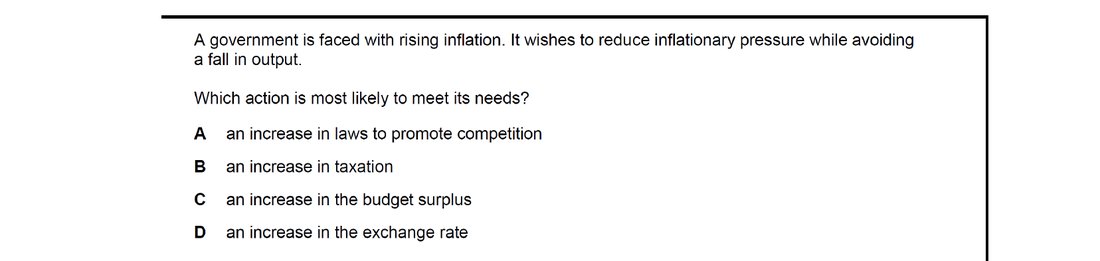
Most anti-inflation measures cut AD and so reduce output. Supply-side policies are the exception: increasing competition raises efficiency and shifts AS rightward, which lowers the price level while increasing — not reducing — real output. Higher taxation, a bigger budget surplus and a stronger exchange rate would each reduce inflation but at the cost of falling output.
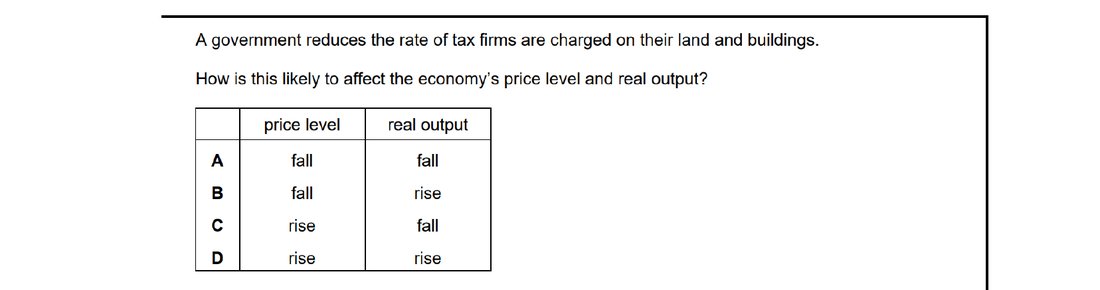
Lowering taxes on firms' property reduces their costs of production, which shifts SRAS to the right. A rightward AS shift simultaneously lowers the price level and raises real output. Hence the predicted combination is a fall in the price level paired with a rise in real output — exactly option B.
24.4The effectiveness of supply-side policies
Spending on education and training has the potential to be very effective in the long run, because it can directly raise the quality of labour and the productive capacity of the economy. In the short run, however, it may be less effective, since it takes a long time to have an effect on the supply side. In the short run it may even contribute to inflation, because increased government spending on education and training raises aggregate demand before it raises aggregate supply.
Providing more education and training may not be very effective if it is not of a high quality, or if it develops skills that will not be in demand in the longer term. Even when training successfully raises workers' skills, costs of production may still rise if pay rises faster than productivity.
Infrastructure development can be expensive and time-consuming. It may take several years to build a new rail link, and by the time the link is finished demand for rail transport may have changed. Different elements of transport infrastructure may not be well linked — for example, new train stations may not be situated close to airports. Infrastructure development may also have harmful effects on the environment.
The overall impact of technological improvement is often beneficial, but its benefits are not always evenly spread and it can harm some. Technological improvement involves change: new products and new methods of production are created, new jobs appear and others are lost. Some people may have to change jobs and move to different areas, and not everyone will cope well with this.
Any supply-side policy tool that raises aggregate supply may fail to raise output if the economy is initially operating with spare capacity. While such a tool will increase productive potential, that potential will not be used if there is not enough aggregate demand. Firms may be capable of producing more, but they will not do so if they do not expect to sell the extra output.
Key concept link — Efficiency and inefficiency
Efficiency is an important concept in assessing whether privatisation and deregulation have increased the performance of the firms that have been affected.
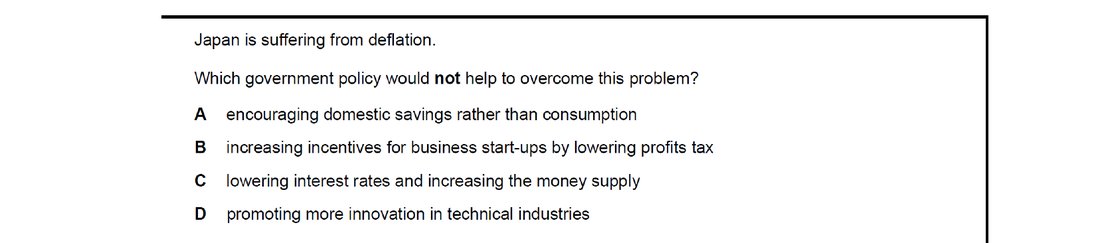
Deflation reflects deficient AD, so a remedy must lift spending. Encouraging savings rather than consumption does the opposite — it reduces consumer expenditure and so reduces AD, deepening the deflation. The other options (lower profits tax to spur start-ups, looser monetary policy, more innovation) all stimulate either AD or AS in a way that helps overcome deflation.
End-of-chapter practice
Past-paper questions from CIE 9708. Pick A, B, C or D. Answers are saved on this device — press Download report (PDF) at the top to save them.
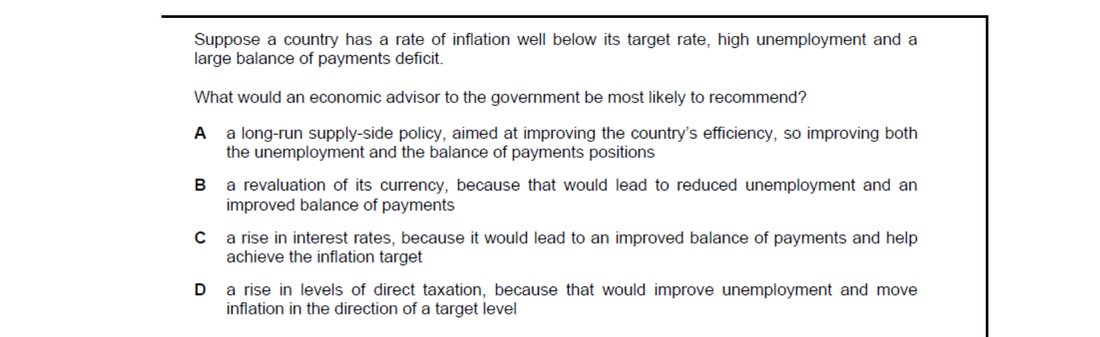
All three problems point to weak productive capacity and competitiveness. A long-run supply-side policy improves efficiency: this lifts productivity, reduces unit costs, and so makes exports more competitive (helping the balance of payments) while expanding capacity and creating jobs (helping unemployment) — all without adding to inflation. Revaluation, higher interest rates or higher direct taxation would each worsen at least one of the three problems.
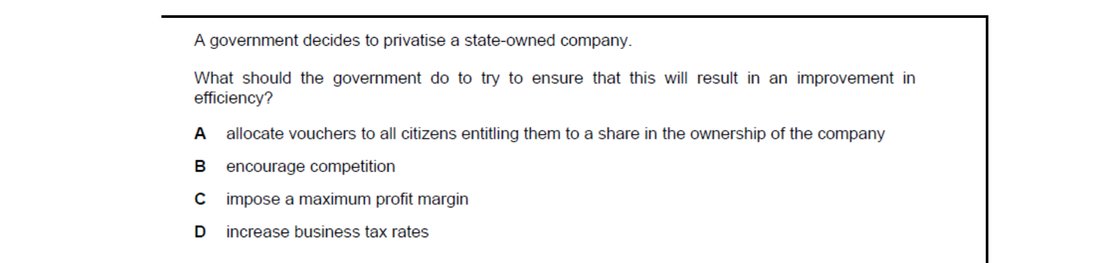
Privatisation alone does not guarantee efficiency; a private monopoly can be just as inefficient as a public one. The efficiency gains come from competitive pressure forcing firms to cut costs, innovate and respond to consumers. So the government should encourage competition in the newly privatised market. Voucher allocation, profit caps or higher business taxes do not directly produce competitive pressure.
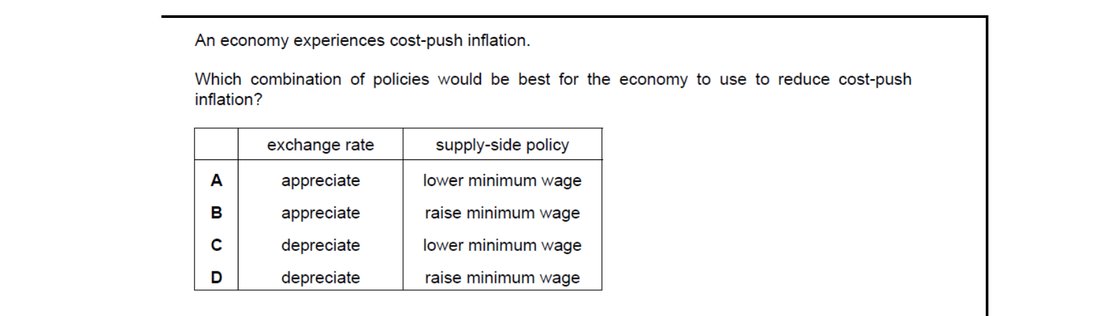
Cost-push inflation comes from rising costs of production, especially imports and wages. Appreciating the currency lowers the domestic price of imported inputs, easing imported cost pressure. Lowering the minimum wage restrains wage costs. Both measures push the SRAS curve to the right and tackle cost-push inflation directly — depreciation or a higher minimum wage would worsen the problem.
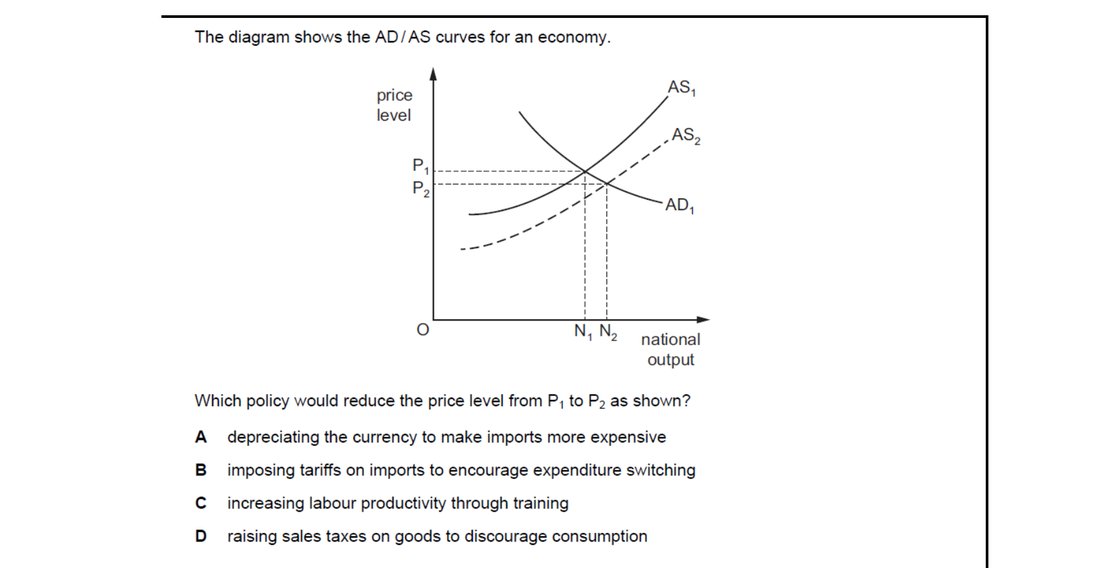
The diagram shows AS shifting rightward and the price level falling. To shift AS rightward you need to raise productive capacity. Training that raises labour productivity does exactly that — supply-side reform. Depreciation, tariffs and higher sales taxes all raise costs or import prices and tend to push the price level up, not down.
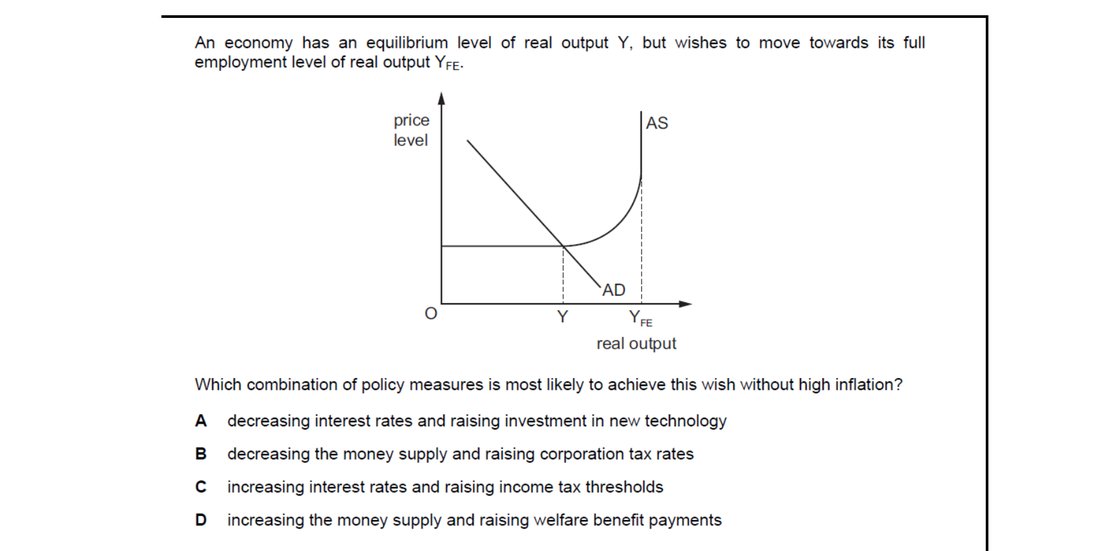
The aim is to raise output up to the full-employment level without much price-level rise. That requires AD to rise alongside an expansion of AS. Lower interest rates expand AD; investment in new technology shifts AS to the right, absorbing the higher AD without significant inflation. The other options either contract AD, raise inflation, or do not raise capacity.
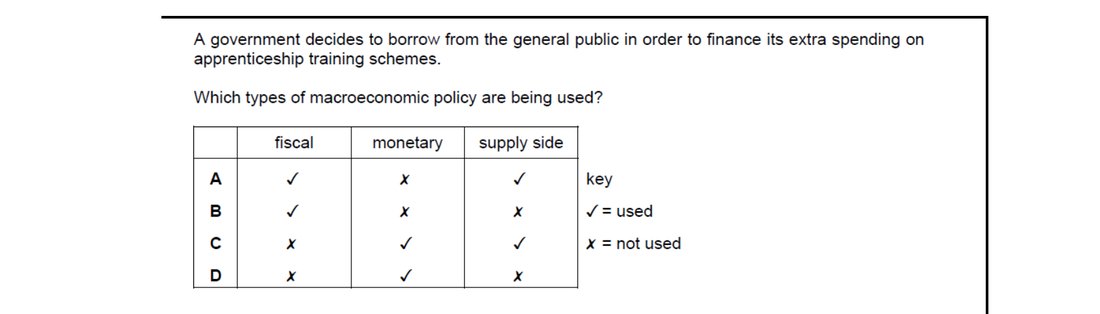
Borrowing to fund extra spending is fiscal policy (deficit-financed expenditure). Apprenticeship training raises workers' skills, productivity and the supply of human capital — a supply-side intervention. Monetary policy is not involved (the central bank is not changing interest rates or the money supply). So fiscal and supply-side policy are used; monetary policy is not.
Attempt the practice questions above to build your score.
Self-evaluation checklist
After studying this chapter, you should be able to:
- Define the meaning of supply-side policy in terms of its effects on LRAS curves.
- Understand the objective of supply-side policies to increase aggregate supply by improving the workings of product and factor markets.
- Explain that governments may use a range of supply-side policy tools: education and training, infrastructure development, support for technological improvement, cuts in corporate tax, cuts in income tax, trade union reform, privatisation and deregulation.
- Use AD/AS analysis to consider the impact of supply-side tools on equilibrium national income, real output, the price level and employment.
Want more practice? Drill this chapter's past-paper MCQs (60 questions) →